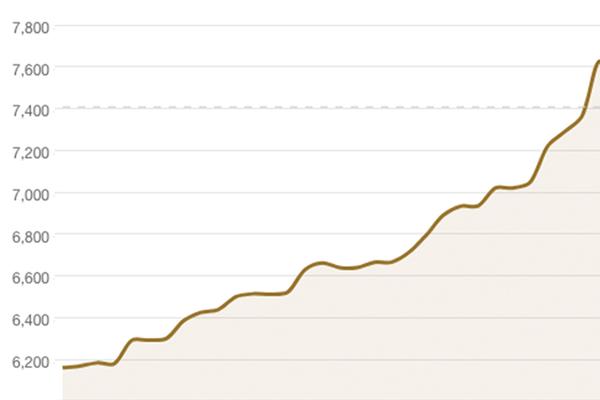
After a strong August, precious metals moved sharply in the other direction during September.
Gold ended the month around US$4,153/oz, down approximately 6%, while silver fell more heavily to around US$60.40/oz, a decline of approximately 9%. Despite the pullback, both metals remained higher over the September quarter, highlighting just how volatile precious metals markets have been this year.
The main story was interest rates. The US Federal Reserve raised rates for the first time in more than three years, while rising oil prices added to inflation concerns and pushed bond yields higher. For much of September, those forces outweighed the traditional support gold might otherwise receive from geopolitical uncertainty.
Short on time?
- Gold fell approximately 6% in September, ending the month around US$4,153/oz.
- Silver declined approximately 9%, ending around US$60.40/oz and giving back much of August's strong gain.
- The Federal Reserve raised its target range for the federal funds rate (Fed’s target range) by 0.25 percentage points to 3.75% to 4.00%, its first increase in more than three years.
- Rising oil prices added to inflation concerns, helping push US Treasury yields higher and strengthening expectations that interest rates could remain elevated.
- The US dollar also strengthened during the month, creating an additional headwind for precious metals priced in dollars.
- Gold and silver both fell to around eight-week lows late in September, although physical demand signals from China remained comparatively firm.
- September showed that geopolitical uncertainty does not automatically translate into higher precious-metal prices when the same events are also pushing energy costs, inflation and interest rates higher.
- Longer-term themes including central-bank diversification, government debt and strong Chinese demand remain in place, but they continue to compete with a difficult short-term interest-rate backdrop.
Precious metals performance at a glance
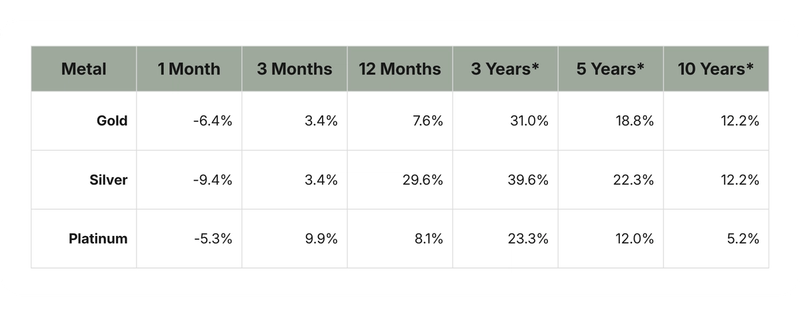
Important: Returns shown are approximate and based on historical spot price data available as at 30 September 2026. Past performance is not a reliable indicator of future performance. This information is provided for general information only and does not constitute financial advice or a recommendation to buy, sell or hold any investment product. *Returns are annualised.
What drove September?

The Fed finally raised rates
The biggest development came in the middle of the month when the Federal Reserve raised its target range for interest rates by 0.25 percentage points to 3.75% to 4.00%.
It was the Fed's first increase in more than three years and followed months of debate about whether persistent inflation would ultimately force policymakers to tighten monetary policy again.
The Fed also indicated that most policymakers expected another increase before the end of 2026. At the same time, its inflation forecasts moved slightly higher, with Chair Kevin Warsh saying that inflation risks remained tilted to the upside (Federal Reserve).
For gold and silver, this matters because higher interest rates increase the potential return available from cash and bonds. Precious metals do not generate an income stream, so higher inflation-adjusted interest rates can make holding them relatively less attractive.

Oil complicated the inflation picture
Geopolitics remained important during September, but not necessarily in the way investors might expect. Normally, escalating conflict can increase demand for gold as a defensive asset. However, the ongoing US-Iran conflict has also kept pressure on global energy markets. Brent crude rose around 14% during September as tensions remained unresolved. Higher energy prices can feed into transport, manufacturing and household costs, making inflation more persistent.
That creates a difficult dynamic for precious metals. The geopolitical uncertainty itself can support demand for gold, while the resulting increase in oil prices can raise inflation expectations, push bond yields higher and increase the likelihood of tighter monetary policy. During September, the second effect generally won.
Gold fell particularly sharply late in the month after oil prices climbed and markets increased their expectations for further Fed tightening. On 28 September alone, gold fell around 4% and reached its lowest level since early August.
Bond yields became a major headwind
September was also an extraordinary month for global bond markets. The US 10-year Treasury yield recorded its largest monthly increase since 2022, while shorter-term yields also rose sharply as markets adjusted to a higher-for-longer interest-rate environment.
This matters because the opportunity cost of holding gold rises when investors can earn a higher return on government bonds. It also helps explain why gold struggled even though many of the themes usually associated with stronger demand remained present.
Geopolitical tensions were elevated, concerns around government debt had not disappeared, and central-bank demand remained an important feature of the market, but the immediate influence of higher yields was simply stronger.

The US dollar added another layer of pressure
The US dollar also strengthened over September. Gold and silver are predominantly priced in US dollars, so a stronger dollar generally makes them more expensive for buyers using other currencies. That can reduce purchasing power for buyers using other currencies and create an additional headwind alongside rising US interest rates.
By the end of September, the combination of a firmer dollar, higher Treasury yields and expectations for further rate increases had pushed both gold and silver back towards levels last seen in early August.
For New Zealand investors, of course, there is another dimension. Changes in the NZD/USD exchange rate can either amplify or offset movements in the international metal price, which is why movements in US-dollar gold do not always translate directly into the same percentage change in New Zealand dollars.

Silver once again moved more aggressively
Silver's approximately 9% decline was larger than gold's, continuing a pattern we have seen repeatedly this year. Silver responds to many of the same investment themes as gold, but its industrial uses also expose it to expectations around manufacturing and economic growth, which can amplify price movements in both directions.
By 29 September, silver had fallen to an eight-week low around US$60.85/oz before recovering slightly. September therefore reversed some of August's silver outperformance and pushed the gold:silver ratio higher again.
This does not necessarily tell us anything definitive about silver's longer-term supply and demand balance. It does demonstrate how easily broader financial-market conditions can dominate those fundamentals over shorter periods.

China provided an interesting counterpoint
One interesting signal during September came from China. While gold prices were falling internationally, buyers in Shanghai were paying a noticeable premium above the London price, suggesting that demand for physical gold remained relatively strong.
China also continued to import large quantities of gold during the year. That matters because it shows there is still underlying demand from one of the world’s largest gold markets, even when short-term investor sentiment is weaker elsewhere. Chinese authorities have also been tightening rules around speculative trading, which suggests more of the recent strength is coming from demand for physical gold.
So, where does that leave us?
September brought precious metals back down to earth after August's strong rebound.
Gold ended the month a little above US$4,150 and silver around US$60, with both metals near two-month lows. Yet neither returned to the much weaker levels seen earlier in the year, and both still recorded gains for the September quarter.
The short-term picture remains dominated by interest rates. Markets entered October debating whether the Fed would raise rates again immediately or wait until later in the year. Softer US inflation data at the end of September reduced expectations for an October increase, although expectations for another move by year-end remained elevated. This is likely to remain a moving target.
Growth and employment data are beginning to show some signs of slowing, while inflation remains above the Fed's target and energy prices continue to create additional uncertainty, making the path of monetary policy unusually difficult to predict.

The longer-term themes themes have not disappeared
September showed that higher interest rates and bond yields can still put significant pressure on precious metals, but the broader reasons investors and central banks have been increasing their exposure to gold have not gone away. Central banks continue to diversify their reserves, government debt and fiscal pressures remain elevated, and geopolitical uncertainty remains a feature of the global environment rather than an occasional shock.
These forces do not necessarily translate into higher prices in the short term, particularly when interest rates are rising and the US dollar is strong. They do, however, help explain why gold has remained relatively resilient despite a much more challenging monetary backdrop than we saw earlier in the year.
The key tension remains the same as we enter the final quarter of 2026: higher rates can weigh on gold and silver, while concerns around debt, currencies, geopolitics and financial-system risk continue to underpin demand for precious metals as portfolio diversifiers.
What this means for investors
After the movements we have seen this year, September was another reminder that precious metals can be volatile even when their longer-term role has not materially changed.
Gold has traded from above US$5,500 in January, through a substantial correction, back above US$4,600 in August and then down towards US$4,150 by the end of September. Silver's swings have been larger still.
Prices respond quickly to interest rates, currencies, positioning, inflation data and geopolitical developments. The reasons investors hold physical precious metals tend to move more slowly, including diversification, scarcity, the absence of counterparty risk and exposure to assets outside conventional financial markets.
That does not mean prices cannot fall further, just as a strong month does not mean prices must continue rising. September simply provided another example of how competing forces can affect the market at the same time.
As we enter the final quarter of 2026, US inflation, interest rates, bond yields, oil prices and developments in the Middle East remain the key variables shaping precious metals markets.

Glossary
Federal funds rate
The interest-rate range targeted by the US Federal Reserve for overnight lending between banks. Changes to this rate can influence borrowing costs, bond yields, currencies and precious-metal prices.
Treasury yield
The return investors receive for holding US government debt. Higher yields can increase the relative appeal of interest-bearing assets compared with gold and silver.
Real interest rate
An interest rate adjusted for inflation. It is often an important influence on gold because gold itself does not generate interest.
Shanghai premium
The difference between the price of gold in Shanghai and major international markets such as London. A positive premium can indicate comparatively strong demand for physical gold in China.
Gold:silver ratio
The number of ounces of silver required to equal the value of one ounce of gold. A rising ratio means gold is outperforming silver, while a falling ratio means silver is outperforming.
Safe-haven asset
An asset that investors may seek during periods of economic, financial or geopolitical uncertainty. It does not mean the asset cannot fall in value.
Disclaimer: This article is for informational purposes only and does not constitute financial advice. Investors should seek independent financial advice before making any investment decisions. Past performance is not a reliable indicator of future performance.
Research basis: September market data are based on the month-end pricing supplied, cross-checked against Reuters, which reported gold down approximately 6.6% and silver approximately 9% late on 30 September. Supporting research includes Reuters, US Federal Reserve, Business Standard and The Economic Times.