After several months of sharp declines, July brought a degree of stability back to precious metals markets.
Gold recorded its first monthly gain since February, while silver remained under pressure but recovered from its mid-month lows. Neither metal has returned to the extraordinary levels reached earlier this year, and the outlook remains highly sensitive to interest rates, inflation and geopolitical developments.
But after the dramatic reset of the second quarter, July offered an important reminder: short-term price movements and the longer-term forces influencing precious metals are not always the same thing.
Short on time?
- Gold ended July around US$4,050/oz, gaining approximately 1% for the month and breaking a four-month run of monthly declines.
- Silver finished around US$57.8/oz, down approximately 2%, after briefly falling below US$55 during the month.
- Interest rates remain the dominant short-term influence. The US Federal Reserve left rates unchanged in July, but three policymakers favoured a rate increase, highlighting the ongoing uncertainty around inflation.
- Geopolitical risk is having a two-sided effect. It supports demand for traditional safe-haven assets, but higher oil prices can also increase inflation expectations and keep interest rates higher for longer.
- Central banks remain significant buyers of gold, with official-sector purchasing strengthening materially during the second quarter.
- Silver's longer-term supply picture remains tight, with the market expected to record a sixth consecutive annual deficit in 2026.
- After an extraordinary start to the year and an equally dramatic correction, gold and silver appear to have entered a period of consolidation rather than returning to the conditions that drove January's surge.
Precious metals performance at a glance
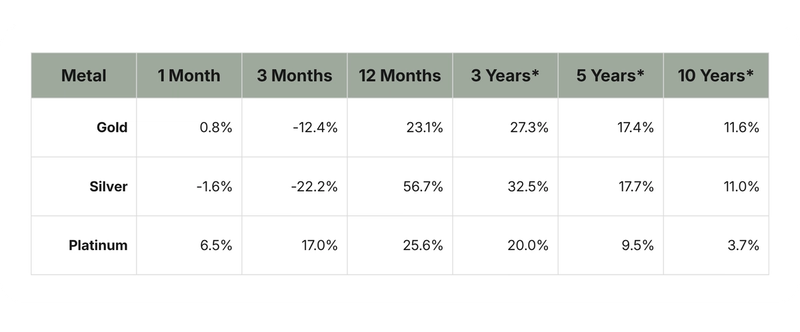 Important: Returns shown are approximate and based on historical spot price data available as at 31 July 2026. Past performance is not a reliable indicator of future performance. This information is provided for general information only and does not constitute financial advice or a recommendation to buy, sell or hold any investment product. *Returns are annualised.
Gold's modest July gain was notable because it ended four consecutive months of declines. Silver remained more volatile, falling to an intramonth low of approximately US$54.75 before recovering towards US$58 by month-end.
Both remain substantially below the record prices reached in January. That retracement has removed much of the speculative momentum that characterised the beginning of 2026 and returned attention to the underlying economic drivers of precious metals.
What drove July?
Interest rates remain the biggest short-term variable
As we discussed last month, one of the biggest changes in the precious metals environment has been the outlook for US interest rates.
The conflict in the Middle East pushed energy prices higher earlier this year, increasing concerns that inflation could prove more persistent than previously expected. Markets consequently moved from anticipating further interest-rate reductions to considering whether the Federal Reserve might ultimately need to raise rates again.
The Fed left US interest rates unchanged at 3.5–3.75% at its July meeting, although three policymakers voted in favour of a 0.25 percentage-point increase. New Fed Chair Kevin Warsh has also taken a less prescriptive approach to communicating the likely path of monetary policy. That means markets may increasingly need to respond to each inflation, employment and economic release rather than relying on clear forward guidance from the central bank.
For precious metals, this matters because higher interest rates, particularly higher inflation-adjusted, or “real”, interest rates, increase the relative attraction of interest-bearing assets compared with gold and silver.
The reverse can also be true when expectations for rates soften. That dynamic was visible late in July, when softer inflation data and a weaker US dollar helped gold recover despite the Fed maintaining a relatively cautious stance.

Geopolitics is no longer a straightforward safe-haven story
Normally, heightened geopolitical risk is considered supportive for gold. That remains true but the current Middle East conflict has added another dimension.
Concerns around oil supply and shipping through the Strait of Hormuz have periodically pushed energy prices higher. Higher oil prices can increase inflation throughout the economy, from transportation and manufacturing to household spending. That creates an unusual tension for precious metals.
Geopolitical uncertainty can increase demand for gold as a defensive asset. But if the same geopolitical event drives inflation higher, markets may expect central banks to keep interest rates elevated, or even raise them, which can work in the opposite direction. This helps explain why gold and silver have sometimes responded unpredictably to geopolitical headlines this year.
The speculative excess has been substantially reduced
Another important change has taken place beneath the surface. January's extraordinary rally attracted significant speculative interest into precious metals. As prices subsequently fell, much of that positioning was unwound.
By July, gold and silver markets looked considerably less crowded. That does not necessarily mean prices must rise from here. But it does mean the market looks very different from the highly speculative conditions surrounding January's peaks.
Gold spent much of July consolidating around the US$4,000 level, while silver traded broadly between the mid-US$50s and low-US$60s. In other words, markets appear to be searching for a new equilibrium.
Silver continues to amplify both sides of the cycle
Silver's volatility has again been significantly greater than gold's. That is nothing unusual. Silver is both a precious metal and an important industrial commodity. It can therefore be influenced by many of the same monetary and geopolitical factors as gold, while also responding to expectations for manufacturing, technology and global economic growth.
The result is typically larger moves in both directions. After trading above US$120 in January, silver briefly fell below US$55 during July – an extraordinary round trip in only six months. That volatility may continue while investors assess both the macroeconomic outlook and silver's underlying physical supply-and-demand position.
So, where does that leave us?
The short-term picture remains uncertain.
For gold, the US$4,000 region has so far attracted renewed interest after the steep second-quarter decline. July's positive month was therefore encouraging from a stabilisation perspective, but it is too early to conclude that the correction has definitively ended.
Silver similarly appears to be establishing a trading range after its much larger decline. Momentum improved towards the end of July, although the metal continues to face the same interest-rate and economic uncertainties affecting gold.
The bigger point is that the market has undergone a substantial reset. Prices are lower. Speculative positioning is lighter. Valuations are less extreme than they were in January. Yet many of the risks that contributed to precious metals' rise over the past several years remain unresolved.

The longer-term tailwinds have not disappeared
Perhaps the clearest structural support for gold continues to come from central banks. Official-sector demand strengthened markedly during the second quarter, with purchasing led by countries including Poland, China, Uzbekistan and Kazakhstan.
This fits into a much broader trend. Central banks have accumulated gold at a dramatically faster pace since 2022 than they did during the preceding decade. The World Gold Council's latest survey also found that a record 45% of central-bank respondents expect their own gold reserves to increase over the next twelve months, while 89% expect global central-bank holdings to rise.
That behaviour matters because central banks are generally strategic, long-term holders rather than short-term traders. Their continued accumulation suggests gold's role as a reserve asset and portfolio diversifier remains important in an increasingly fragmented global financial system.
Read more about this - "China's Central Bank Adds 20 Tons to Gold Reserves in July" - Bloomberg News
Geopolitical, political and fiscal uncertainty remain elevated
The world has not become noticeably more predictable simply because gold and silver prices have fallen. The Middle East remains unstable. Relations between major global powers remain strained. Trade and tariff policy continue to evolve.
At the same time, large government deficits and rising public debt across many developed economies remain unresolved. The United States faces its own combination of fiscal pressure, political uncertainty and an increasingly contested monetary-policy environment heading towards the mid-term elections and, beyond that, another debt-ceiling debate.
None of these factors guarantees higher precious-metal prices. But collectively they reinforce many of the reasons gold has historically been held as a long-term store of value and portfolio diversifier.
Read more about this - "Commerzbank downgrades gold and silver prices as Middle East conflict takes its toll" Kitco.com
Financial-market concentration remains another risk to watch
Equity markets have also become unusually concentrated around a relatively small number of very large technology and artificial-intelligence businesses.
That does not diminish the extraordinary potential of AI. But high valuations, large capital expenditure commitments and concentration of market returns naturally raise questions about diversification should investor sentiment change.
That broader backdrop – high asset valuations, elevated sovereign debt and increasingly correlated financial markets – is another reason investors continue to examine assets that behave differently from conventional equities and bonds.
Read more about this - Financial market concentration remains another risk to watch: J.P Morgan
Silver's structural supply story remains intact
Silver has an additional dimension that gold does not: substantial industrial consumption. Its conductive properties make it difficult to replace across numerous applications including electronics, vehicles, power infrastructure, data centres and artificial-intelligence technology.
There are some important nuances. High silver prices have encouraged manufacturers, particularly in solar, to use less silver or substitute alternative materials where possible, and overall industrial demand is expected to soften somewhat this year.
Despite that, the Silver Institute expects the global silver market to remain in deficit for a sixth consecutive year in 2026. Supply is also relatively slow to respond to higher prices because much of the world's silver is produced as a by-product of mining other metals.
This does not prevent significant short-term price declines, as 2026 has demonstrated very clearly, but it remains an important part of silver's longer-term market structure.
What this means for investors
July was considerably quieter than the first six months of 2026, but that may be exactly what precious metals markets needed. Gold's extraordinary rally was followed by a substantial correction. Silver's movements were even more dramatic.
Periods like this are a reminder of the volatility inherent in precious metals and of the difficulty of forecasting short-term prices. They are also a reminder to distinguish between price and purpose.
The day-to-day price of gold and silver will continue to respond to interest rates, inflation data, currencies, positioning and geopolitical headlines.
The longer-term reasons investors hold physical precious metals tend to change much more slowly: diversification, scarcity, the absence of counterparty risk, protection against extreme economic or financial outcomes, and particularly for gold, its role as a globally recognised store of value.
July did little to resolve the competing forces currently affecting precious metals. But after one of the most volatile six-month periods in recent history, the market appears to be moving from extreme momentum, through a substantial reset, and now towards a search for equilibrium.
What comes next will depend heavily on inflation, US monetary policy, oil prices and the geopolitical environment. For now, those are exactly the factors we will continue to watch.

Glossary
Real interest rates: Interest rates adjusted for inflation. Higher real rates can make interest-bearing assets relatively more attractive compared with non-yielding assets such as gold.
Federal Reserve / Fed: The central bank of the United States, whose interest-rate decisions can materially influence the US dollar, bond yields and precious-metal prices.
Official sector: Central banks, sovereign wealth funds and certain other government-related institutions that hold reserve assets such as gold.
Market deficit: A period where annual demand for a commodity exceeds newly mined and recycled supply, requiring the difference to be met from existing inventories.
Gold:silver ratio: The number of ounces of silver required to purchase one ounce of gold. It is commonly used as a measure of the relative value and performance of the two metals.
Disclaimer: This article is for informational purposes only and does not constitute financial advice. Investors should seek independent financial advice before making any investment decisions. Past performance is not a reliable indicator of future performance.
Sources used for market data and background: Reuters; Federal Reserve; World Gold Council; Silver Institute.