After several months of correction and consolidation, momentum returned to precious metals in August.
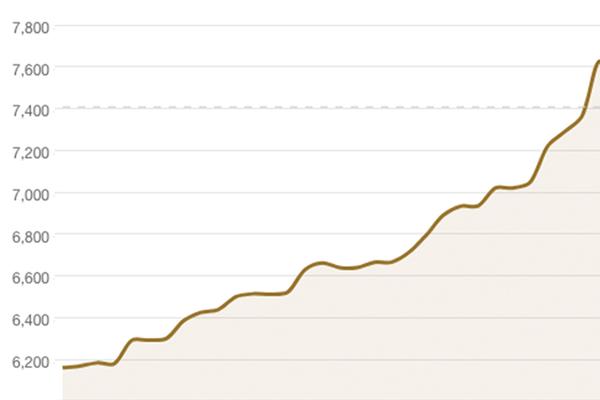
Gold finished the month around US$4,439/oz, approximately 10% higher than a month earlier, while silver rose even more strongly, ending around US$66.56/oz, up approximately 16%. Both recorded their strongest monthly performance since January.
The rally was not a straight line. Gold traded above US$4,600 during the month before falling sharply after Federal Reserve Chair Kevin Warsh used his Jackson Hole speech to reiterate concerns about inflation. That late-month reversal was a useful reminder of the competing forces currently influencing precious metals: slowing economic growth and elevated financial and geopolitical risks on one side, and the prospect of higher interest rates on the other.
Short on time?
- Gold rose approximately 10% in August, ending the month around US$4,439/oz.
- Silver gained approximately 16%, ending around US$66.56/oz and materially outperforming gold.
- The gold:silver ratio fell from around 70.5 to 66.7, reflecting silver's stronger performance during the month.
- Gold broke above the trading range that had contained it through much of June and July, while investment activity also began to strengthen.
- Central-bank demand remains an important long-term influence, although buying in the first half of 2026 was below the extraordinary levels of recent years.
- The outlook for US interest rates remains the dominant short-term variable. Warsh's Jackson Hole comments sharply increased market expectations of another rate rise.
- Silver's supply-demand position remains relatively tight, but the underlying story is more nuanced as some industrial demand, particularly solar, is moderating.
- August therefore strengthened the case that precious metals have moved beyond the extreme correction seen earlier this year, but it certainly did not remove the potential for further volatility.
Precious metals performance at a glance
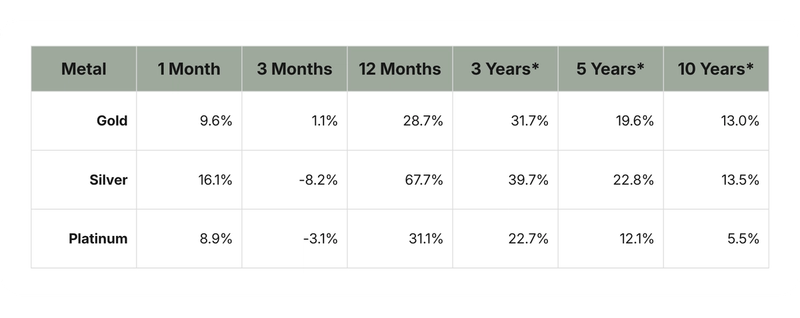
Important: Returns shown are approximate and based on historical spot price data available as at 31 August 2026. Past performance is not a reliable indicator of future performance. This information is provided for general information only and does not constitute financial advice or a recommendation to buy, sell or hold any investment product. *Returns are annualised.
The move was particularly notable following the very different conditions earlier in the year. Gold and silver remain well below their extraordinary January peaks, but August represented a meaningful acceleration from the more tentative stabilisation we saw during July.
Silver's outperformance also pushed the gold:silver ratio down to approximately 66.7, from around 70.5 a month earlier.
What drove August?
The interest-rate picture initially became more supportive
Interest rates continue to sit at the centre of the precious-metals story. During the first part of August, markets became less convinced that the Federal Reserve would need to tighten monetary policy aggressively. US real bond yields eased from their late-July highs and the US dollar softened.
That combination generally reduces one of the major headwinds facing precious metals. Gold does not pay interest, so when inflation-adjusted bond yields fall, the opportunity cost of holding it also declines.
Gold responded by breaking above the US$3,950-US$4,200 range that had contained prices through much of the northern summer. By late August, it had moved back above its 200-day moving average, another sign that market momentum had changed.

Investment demand returned
The August move was also accompanied by signs of renewed investor participation.
Gold-backed ETF buying strengthened materially during the month, while futures trading volumes and open positions also increased. This matters because movements in gold are often driven at the margin by financial investors moving into or out of the market.
It represents a change from the second quarter, when enthusiasm had cooled significantly following January's surge. August therefore appears to have been more than simply a technical bounce. Investor interest returned as prices strengthened, although activity remained below the extraordinary levels recorded around January's peak.

Silver finally joined the rally
One of August's most notable developments was silver's stronger participation. Silver rose approximately 16.5% during the month compared with gold's approximately 10% gain. That is more consistent with silver's historical tendency to make larger moves than gold when precious-metal sentiment strengthens.
The reason is silver's unusual position between two worlds. Like gold, silver can attract investment demand during periods of financial, monetary and geopolitical uncertainty. But it is also an important industrial commodity used across electronics, vehicles, power infrastructure and other applications.
This combination can amplify moves in either direction. It contributed to silver's spectacular rise early this year, its subsequent collapse, and now its stronger August recovery.

Then Jackson Hole changed the conversation
The strongest reminder of that volatility arrived towards the end of the month. Federal Reserve Chair Kevin Warsh used his Jackson Hole address to reinforce the Fed's commitment to returning inflation towards its 2% target. Markets interpreted his comments as increasing the possibility of another interest-rate rise.
Gold fell more than 3% on the day, while silver declined around 3.5%. By month-end, markets were pricing roughly a 64% probability of a September rate increase, compared with around 36% before Warsh's comments. (Reuters)
The episode neatly illustrates the tension facing the Fed. Economic growth and employment are showing signs of slowing, which would normally argue against tighter policy. But inflation remains elevated, while higher oil prices associated with the Middle East conflict create further inflationary pressure.
There is therefore no obvious path for monetary policy, and markets are likely to remain highly sensitive to incoming economic data.

Geopolitics continues to cut both ways
The Middle East also remained an important influence throughout August. Normally, escalating geopolitical uncertainty tends to support gold through increased demand for defensive assets.
But as we discussed last month, the current situation is more complicated. Disruption to oil supplies can push energy prices higher, which in turn increases inflation expectations and potentially strengthens the case for higher interest rates. That means the same geopolitical event can simultaneously create a reason to own gold and a monetary-policy headwind for its price.
We saw that tension again at the end of August as renewed conflict around the Strait of Hormuz pushed oil prices higher at the same time that markets were reassessing the outlook for US interest rates. (Reuters)
So, where does that leave us?
August strengthened the evidence that the precious-metals market has moved beyond the conditions that dominated the second quarter.
Gold has broken above its recent trading range. Silver has begun participating more strongly. Investment demand has improved. And many of the speculative positions that built up during January's extraordinary rally had already been removed during the subsequent correction.
But it would be premature to conclude that the path from here is straightforward.
The sharp reaction to Jackson Hole showed just how sensitive the market remains to interest-rate expectations. Although gold has technically broken higher, investor sentiment may not yet have fully reset following the enormous rally that preceded this year's correction.
In other words, the market looks healthier than it did several months ago, but not necessarily calmer.

The longer-term themes remain
Central banks continue to accumulate gold
Central banks remain one of the most important structural sources of gold demand. Purchasing rebounded strongly during the second quarter to approximately 289 tonnes, up 62% compared with the same period last year. The first-half total of around 345 tonnes was softer than the exceptional buying seen in recent years, but still elevated compared with longer-term historical averages.
Goldman Sachs Research also continues to identify reserve diversification as a multi-year trend, estimating that central-bank buying in 2026 remains substantially above the monthly average recorded before 2022.
The significance is less about what central banks do in any individual month and more about the motivation behind their purchases: diversification, geopolitical risk, inflation protection and reducing reliance on foreign-currency reserves. Those motivations have not disappeared.
Read more about this - "Gold Is Forecast to Climb as Central Banks Buy the Precious Metal" - GOLdman sachs
Government debt and fiscal risk remain unresolved
Another theme attracting increasing attention is government debt. US public debt has continued to rise while long-term borrowing costs remain elevated. State Street notes that debt held by the public is projected to rise from around 100% of US GDP in 2026 to 121% by 2036.
That creates a difficult dynamic. Higher rates increase the cost of servicing government debt. But cutting rates too aggressively while inflation remains elevated risks weakening confidence in monetary policy and currencies.
Gold has historically attracted attention during periods when investors become concerned about either side of that equation. This is also why the simple rule that “higher interest rates are always bad for gold” does not necessarily hold. The reason rates are rising can matter just as much as the rate itself.
Read more about this - "Structural rise in real interest rates: Treasury premium erosion and asset allocation implications" State street
Silver's fundamentals remain tight, but the picture is nuanced
Silver's underlying market deserves some qualification. The global market is expected to record a sixth consecutive annual supply deficit in 2026, continuing a significant cumulative draw on above-ground metal.
However, not every component of demand is increasing. Industrial fabrication is expected to decline modestly this year, while photovoltaic demand is forecast to fall materially as solar manufacturers reduce the amount of silver used in each cell and increasingly explore substitutes. At the same time, recycling supply is rising in response to higher prices.
Investment demand has therefore become increasingly important to maintaining the overall deficit. That does not make silver's structural story unimportant. It simply means that a market deficit on its own should not be interpreted as a guarantee of higher prices.
What this means for investors
August provides another useful example of why precious metals cannot easily be explained by a single variable.
Gold rallied while economic growth was slowing. It rallied while geopolitical risk remained high. It rallied as bond yields initially softened, then fell sharply when the interest-rate outlook changed again. Silver amplified those movements.
For investors in physical bullion, that volatility reinforces the distinction we have discussed previously between price and purpose.
Short-term prices can move significantly based on economic data, central-bank commentary, currency markets and investor positioning.
The reasons people hold physical gold and silver tend to evolve much more slowly: diversification, scarcity, the absence of counterparty risk and exposure to assets outside the traditional financial system.

For New Zealand investors, there is another variable as well. Gold and silver are predominantly priced internationally in US dollars, so movements in the NZD/USD exchange rate can either amplify or offset changes in the global metal price.
After July's stabilisation, August clearly represented a return of momentum. Whether that develops into a sustained move or another period of consolidation will depend heavily on inflation, employment, US interest rates and geopolitical developments.
And, as the final few days of August demonstrated, markets are likely to continue changing their minds quickly.
Glossary
Real interest rates: An interest rate adjusted for inflation. Higher real rates generally increase the relative attraction of interest-bearing assets compared with non-yielding assets such as gold.
200-day moving average: The average price of an asset over the previous 200 trading days. It is commonly used as one indicator of longer-term market trends.
Gold-backed ETF: An exchange-traded fund that generally holds physical gold and allows investors to gain exposure to gold through a financial-market security.
Gold:silver ratio: The number of ounces of silver required to equal the value of one ounce of gold. A falling ratio generally means silver is outperforming gold.
Disclaimer: This article is for informational purposes only and does not constitute financial advice. Investors should seek independent financial advice before making any investment decisions. Past performance is not a reliable indicator of future performance.
Supporting research includes Reuters, Heraeus Precious Metals, World Gold Council data referenced by State Street, Goldman Sachs Research, J.P. Morgan Global Research and CPM Group.